
Sabi Sands vs Timbavati vs Manyeleti: Which Greater Kruger Reserve?
Sabi Sands vs Timbavati is one of the most common decisions travellers make when planning a Greater Kruger safari. Although Sabi Sands, Timbavati and Manyeleti share unfenced borders with Kruger National Park, each reserve offers a different wildlife experience, price point, lodge style and level of exclusivity.
Here is a frank comparison of all three.
Sabi Sands Game Reserve
Sabi Sands is the world’s most famous private game reserve. Its reputation rests primarily on its leopard sightings — a product of decades of vehicle habituation by individual leopards who have grown up around game drive vehicles and treat them as moving rocks. At the best Sabi Sands properties (MalaMala, Londolozi, Singita Ebony, Sabi Sabi Earth Lodge), a leopard encounter is not a lucky sighting: it is a sustained, close-range interaction with an animal behaving naturally — carrying a kill, greeting a cub, scent-marking a territory — at distances of five to fifteen metres. This is not replicated anywhere else in Africa.
Wildlife
Beyond leopard, Sabi Sands carries all Big Five species in high density. Lion prides are well-known to guides and reliably located; elephant herds move between Kruger and the private reserves freely through the unfenced boundary. Cheetah and wild dog are present but less consistently seen than the main predators. The reserve’s guiding standards are among the highest in South Africa — Sabi Sands produces many of the country’s most experienced FGASA Level 3 guides.
Lodges and Cost
Sabi Sands operates at a premium to the rest of the Greater Kruger market. Top-tier properties — Singita Boulders, Singita Ebony, MalaMala Main Camp, Londolozi Varty Camp — run from R25,000 to R60,000+ per person per night, fully inclusive. The mid-tier (Arathusa, Nkorho Bush Lodge) offers the same reserve at R10,000–R18,000 pps/night. There is no meaningful “budget” option within the Sabi Sands fence; you pay for the reserve’s reputation and the quality of its guiding infrastructure.
Vehicles per Sighting
This is Sabi Sands’ most significant drawback. The reserve’s fame and the density of lodges within its boundaries mean that a predator sighting — particularly a leopard — can attract multiple vehicles. At peak season with a mid-tier lodge, encountering four to six vehicles at a leopard sighting is not unusual. Premium lodges have access-restricted areas and operate with fewer vehicles per concession, which substantially improves the experience at the cost of a higher rate.
Timbavati Game Reserve
Timbavati shares its northern boundary with Sabi Sands and the same unfenced connection to Kruger, but operates at a meaningfully lower price point and with a different atmosphere. The reserve is best known outside South Africa for its white lions — a genetic rarity caused by leucism (not albinism) first documented here in 1975, the subject of the Wildlife ACT conservation programme and the inspiration for significant global attention. White lions appear in the reserve’s prides at irregular intervals; sightings cannot be guaranteed but do occur.
Wildlife
Timbavati’s wildlife profile is comparable to Sabi Sands — the same ecosystem, the same species, the same seasonal movements. Leopard sightings are less predictable than in Sabi Sands (fewer decades of individual habituation, slightly less guide infrastructure around specific animals) but are regular and often excellent. Lion prides are well-tracked across the reserve’s lodges; elephant movement is significant, particularly in the late dry season when herds move between the private reserve and Kruger.
Lodges and Cost
Timbavati’s pricing sits below Sabi Sands at every tier. Top lodges — Tanda Tula Field Camp, Kings Camp, Ngala Private Game Reserve (CC Africa), Simbambili — run from R12,000 to R25,000 pps/night. The mid-tier (Motswari, Umlani) offers good-quality guiding and a more rustic atmosphere at R8,000–R12,000 pps/night. Value relative to Sabi Sands is the single strongest argument for Timbavati, particularly at the mid-tier where the wildlife quality is comparable and the price is not.
Vehicles per Sighting
Fewer lodges, fewer vehicles per kilometre, fewer vehicles per sighting. The Timbavati experience is consistently less crowded than Sabi Sands. This is the reserve’s underappreciated advantage — the combination of Kruger-equivalent wildlife with a materially more intimate game drive experience.
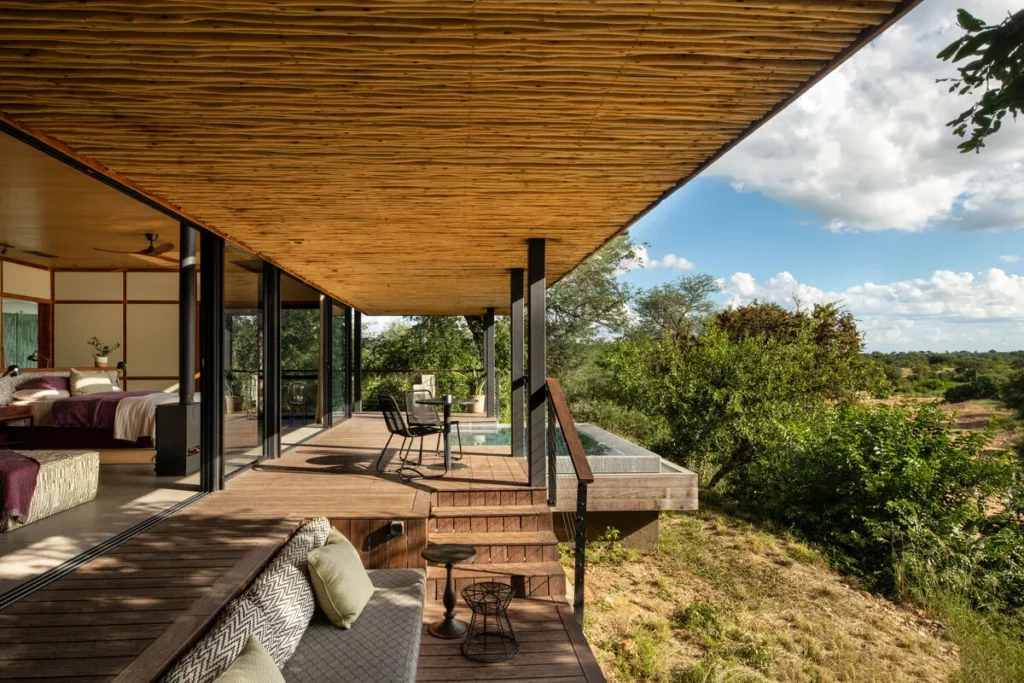
Manyeleti Game Reserve
Manyeleti is the outlier in this comparison. At approximately 23,000 hectares, it is smaller than both Sabi Sands and Timbavati, and it has historically been the least commercially developed of the three reserves — which is its primary advantage. Vehicle density is the lowest in the Greater Kruger private reserve system. Sightings, when they occur, are typically with fewer vehicles, and the bush experience has a more genuine wilderness quality than either of the better-known reserves.
Wildlife
Manyeleti shares the same Greater Kruger ecosystem as Sabi Sands and Timbavati. The same species move freely across the unfenced boundaries; lion, leopard, elephant, rhino, and buffalo all occur within the reserve. Leopard sightings are less structured than in Sabi Sands — individual animals are less thoroughly habituated — but can be outstanding. The reserve’s lower vehicle density means that sightings of any species tend to be more intimate.
Lodges and Cost
Manyeleti operates at the most accessible price point of the three reserves. Honeyguide Tented Safari Camp and Khoka Moya (the reserve’s main operators) run from R6,000–R10,000 pps/night. Kings Camp (shared with Timbavati) also operates on the Manyeleti side. These are not budget lodges — guiding and facilities are to a genuine four-star standard — but they represent substantially better value than Sabi Sands equivalent properties.
The Verdict
Choose Sabi Sands if: Leopard sightings are your primary objective, budget is not the primary constraint, and you want the reserve that has set the global standard for the private game drive experience. The premium lodges (Singita, MalaMala) justify their rates for travellers for whom this is a once-in-a-decade trip.
Choose Timbavati if: You want Kruger-ecosystem wildlife quality at 50–70% of Sabi Sands pricing, a less crowded game drive experience, and the possibility (not guarantee) of encountering white lions. The reserve’s combination of value, wildlife quality, and atmosphere makes it the strongest all-round choice for most international travellers.
Choose Manyeleti if: You want the most authentic, least commercialised Greater Kruger experience, vehicle-per-sighting counts are important to you, and you are working with a tighter budget that cannot accommodate Sabi Sands or the upper Timbavati tier. Manyeleti is the connoisseur’s choice.
All three are served by the same airport (Hoedspruit or Phalaborwa for Timbavati and Manyeleti; Skukuza or Hoedspruit for Sabi Sands) and can be combined in a split itinerary for travellers with ten or more days.
Choose Your Greater Kruger Reserve
African Safari Group books across all three reserves and knows the lodges in detail. Tell us your priorities — leopard sightings, value, intimacy, white lions — and we will match you to the right property and build the itinerary.