
Luxury Safari Africa: What Makes a World-Class Safari?
Luxury safari Africa experiences are among the most sought-after in the travel industry, but the word “luxury” has been applied so broadly — to everything from Maldivian-style overwater suites transplanted to the bush to basic camps with decent mattresses — that it has nearly stopped carrying meaning. A genuine definition requires more precision: what actually separates a world-class safari experience from a merely expensive one?
This guide sets out what the best safari operators, guides, and lodges actually deliver — and how to identify it before you book.
What Defines a Luxury Safari Africa Experience?
No element of safari quality matters more than the guide. A poor guide in the world’s best lodge is a mediocre safari. An exceptional guide in a modest camp is a transformative experience.
What distinguishes a world-class safari guide: Field Guides Association of Southern Africa (FGASA) Level 3 qualification or equivalent (in East Africa, Kenya Professional Safari Guides Association Master Guide), sustained experience tracking specific individual animals in a specific reserve over multiple years, the ability to read landscape and animal behaviour ahead of the event rather than reacting to it, and the rare quality of being able to explain complex ecological relationships — predator-prey dynamics, plant succession after fire, the role of dung beetles in nutrient cycling — in terms that are engaging rather than didactic.
Guiding quality is difficult to assess from a lodge website. The most reliable proxy: ask your safari specialist whether they have personally travelled with the guides at their recommended properties. ASG’s team makes this a non-negotiable part of our assessment process.
The Vehicle and the Sighting
The game drive vehicle defines much of the physical experience. Open Land Cruisers or Land Rovers with elevated, tiered seating give all passengers clear sightlines regardless of position — this matters more than it sounds when you are tracking a leopard through thick bush at dawn. The difference between a three-row elevated cruiser and a converted minibus is significant, and it shows in the quality of both the viewing and the photography.
Vehicle density at a sighting is the second variable. The best lodges operate on exclusive concessions or in reserves where a communal code limits the number of vehicles at any single sighting. At MalaMala in Sabi Sands, for example, a leopard sighting is typically shared between vehicles from a very small number of lodges. At overcrowded reserves without this discipline, twelve vehicles at a cheetah kill is not unusual. This is not a luxury experience regardless of what the lodge charges per night.
Off-Road and Night Drives
The national parks (Kruger, Addo, the Serengeti) prohibit off-road driving and night drives. Private reserves, by contrast, permit both — and the difference they make to the safari experience is substantial.
Off-road driving allows guides to follow animal movements through dense bush, approach predator sightings from optimal angles, and position the vehicle for photography without being constrained by a road network designed for rangers rather than game viewing. Night drives — conducted with spotlights after dark — reveal nocturnal species (leopard on the move, civets, bush babies, bat-eared foxes, porcupines, brown hyena) that are simply invisible on a daylight drive. The most dramatic leopard encounters in Sabi Sands frequently occur on night drives when individual animals are moving freely without the daylight heat suppression.
If a safari property does not offer off-road driving and night drives, it is not a private reserve experience regardless of what it costs.
Bush Walks — The Ground-Level Dimension
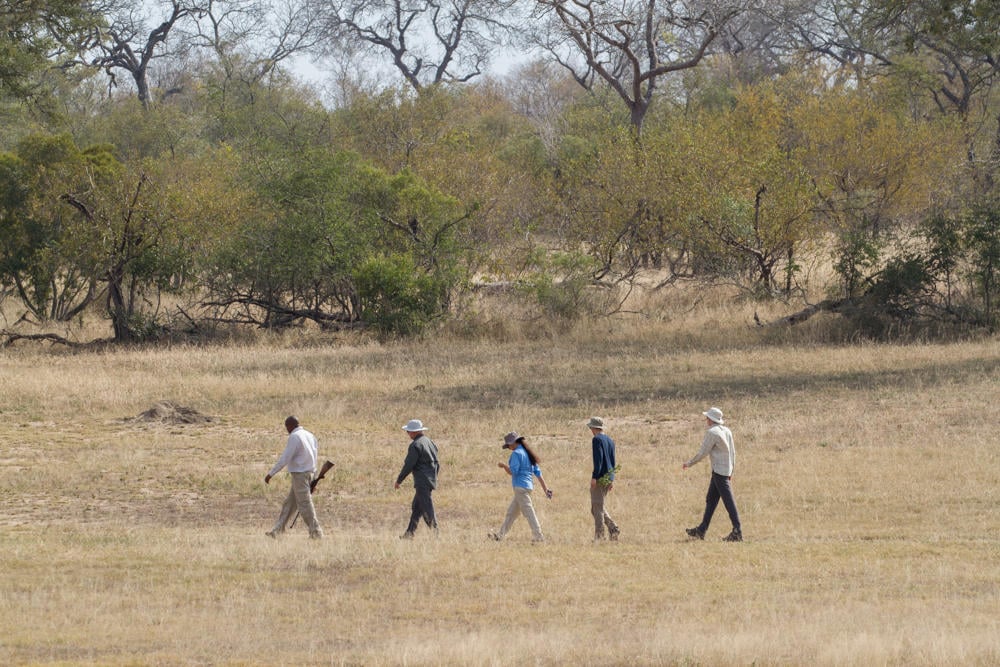
A game drive, however excellent, is a vehicle-mediated experience. A guided walking safari — on foot, in the bush, with an armed ranger, in territory that contains lion, elephant, and buffalo — belongs to a different category of engagement. The landscape scales differently at ground level: a two-metre termite mound that reads as a smudge from a vehicle becomes a significant structure from the ground. Tracking spoor in soft sand, identifying the dung beetle rolling a ball of buffalo dung three times its own weight, smelling the musth-glands of a bull elephant from thirty metres — these are experiences that a vehicle drive literally cannot deliver.
The best luxury safari lodges include guided walking safaris as a standard part of the programme, not as an add-on. Walking safaris require FGASA armed response qualification; the quality and the approach of the guide matter even more on foot than in a vehicle.
The Lodge — Architecture, Food, and Restraint
Lodge architecture at the best properties serves the landscape rather than competing with it. Singita’s lodges use stone, canvas, and wood in ways that feel rooted in the African savannah; the design brief was clearly about disappearing into the bush rather than imposing a design identity onto it. Cheaper lodges often do the opposite: imported European furniture, harsh artificial lighting, air conditioning units mounted on thatched walls. The physical disconnect from the landscape is the tell.
Food quality at the best safari lodges is genuine and seasonally responsive. The Kruger and Eastern Cape regions have strong local food cultures — game meat from the reserve, locally sourced vegetables, South African wines. Lodges that serve interchangeable hotel buffet food in a boma setting are missing the most obvious opportunity to connect the dining experience to the destination.
Restraint is the hardest luxury quality to define and the most important. The best lodges know when to leave you alone. A guide who does not fill every silence with commentary. A manager who does not interrupt a sunset drink with another sundowner speech. A room that has been prepared without unnecessary turndown chocolates and bed-sculpture towels. The absence of unnecessary performance is, paradoxically, the most confident statement of quality.
The Wilderness Itself
All of the above is rendered meaningless by the wrong landscape. A five-star lodge surrounded by a degraded, overstocked reserve with inadequate wildlife management is not a luxury safari — it is an expensive hotel in a game park. The underlying health and management quality of the reserve is the foundation on which every other element of the experience depends.
The markers: anti-poaching investment and effectiveness, predator population health, prey species diversity and population stability, vegetation management, and — most observable on a single visit — the naturalness of animal behaviour. Habituated animals that have been fed by lodge staff or that associate vehicles with food provisioning are not exhibiting natural behaviour; their reactions to predators, to each other, and to the vehicle are distorted. The reserves that refuse to habituate animals with food are the ones where the wildlife experience is genuinely honest.
Find a World-Class Safari
African Safari Group assesses every lodge we recommend against the criteria in this guide. Our specialists travel to the reserves, drive with the guides, and evaluate the experience before recommending it. Tell us your priorities and we will match you to the safari that earns the word luxury.