
Best Time to See the Great Migration: Month-by-Month Guide
When Is the Best Time to See the Great Wildebeest Migration?
The best time to see the Great Wildebeest Migration depends entirely on which phase of the migration you want to experience. The Mara River crossings in Kenya’s Masai Mara — the most dramatic and photogenic phase — occur between July and October, with August and September offering the highest probability of witnessing crossings. The calving season in Tanzania’s southern Serengeti (January–February) is equally extraordinary and far less crowded. There is no single universally best time; each phase offers a different, world-class experience.
January and February: Calving Season (Southern Serengeti)
Calving season in the Ndutu region of Tanzania’s southern Serengeti is one of wildlife’s greatest spectacles, and remains surprisingly underappreciated. Approximately 8,000 wildebeest calves are born per day at peak, and the savannah fills with newborns taking their first steps within minutes of birth. Predators converge from across the ecosystem: cheetah mothers teach cubs to hunt; lion prides work cooperatively; hyena clans are constantly active. The green season brings spectacular skies and lush landscapes. Ndutu and southern Serengeti camps offer far less congested wildlife viewing than the peak July–October season.
April to June: Green Season (Central/Western Serengeti)
The long rains (April–May) see many Serengeti camps close or reduce operations. June marks the beginning of the dry season and the start of the migration’s northward push. The Grumeti River crossings (June–July) in the western Serengeti are smaller but excellent, with large Nile crocodiles. June is an excellent month — rains have ended, migration is moving, and prices are lower than peak August–September before the crowds return.
July to October: The Mara River Crossings (Kenya)
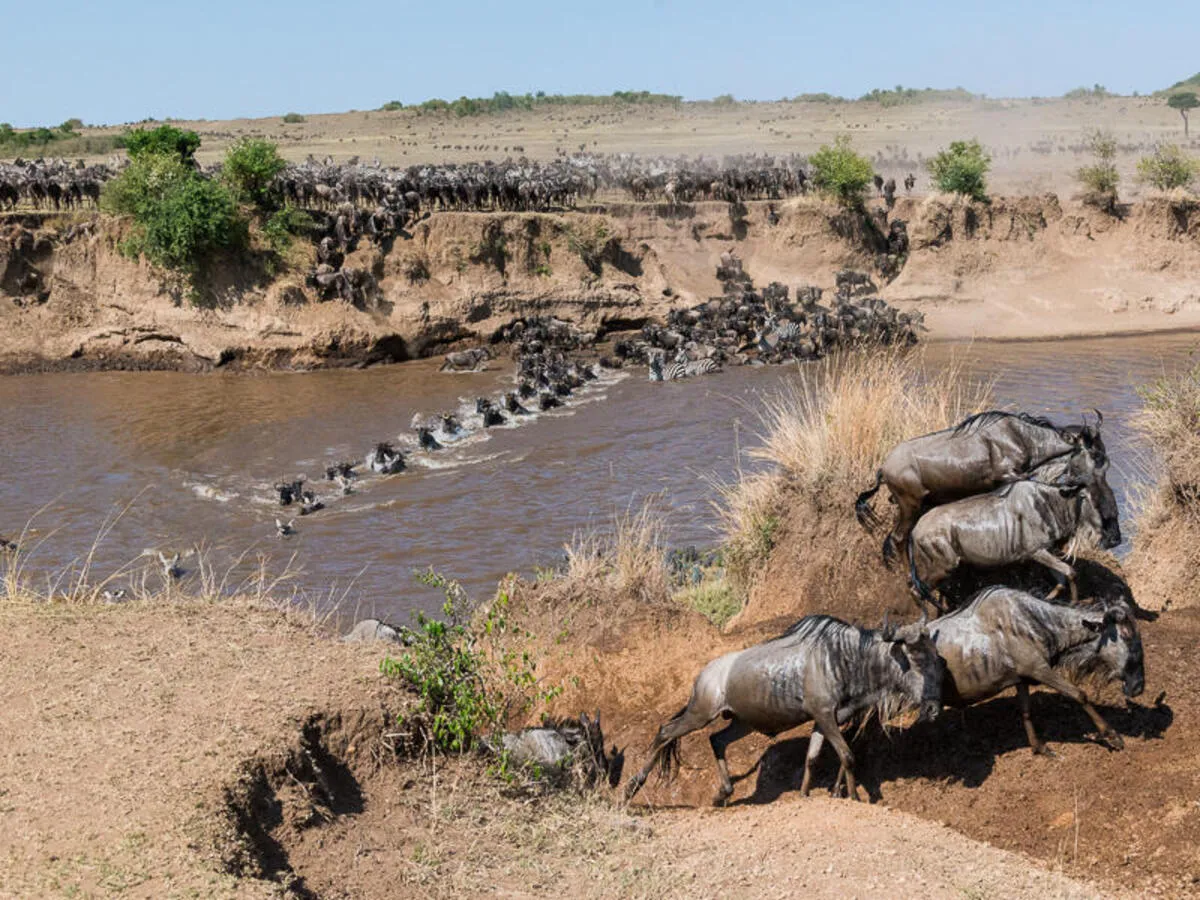
This is the migration’s signature moment — wildebeest gather in their tens of thousands on the Mara River banks, working up the courage (sometimes for hours or days) before plunging into the crocodile-filled water. The chaos and drama of a crossing, with crocodiles exploding from the water and wildebeest scrambling up the far bank, is like nothing else in nature. The Masai Mara hosts the northern leg of the migration during these months. August and September are statistically the most likely crossing months; July begins the season and October is the tail end. Private conservancy camps in the Masai Mara book 12–18 months in advance for August and September.
November to December: The Short Rains (Serengeti)
The short rains (November–December) bring the herds back south through the central Serengeti toward their calving grounds. Vegetation turns green, skies are dramatic with thunderheads and golden light, and the Serengeti is at its most beautiful. Tourist numbers drop significantly compared to peak season, and rates at many camps are reduced. Wildlife remains excellent; this is an underrated time to visit for photographers seeking dramatic light and fewer vehicles.
How Far in Advance Should You Book?
For peak migration season (August–September Masai Mara), the best camps book 12–18 months in advance. For January–February calving season, 6–9 months ahead is appropriate. Shoulder season (June, October, November) is more accessible with 3–6 months lead time. If you are flexible on exact dates, some camps release cancellations 6–8 weeks before arrival — but for a specific peak-season experience, early booking is non-negotiable.
Enquire Now — we book migration camps across the full annual cycle and can secure the best available options for your preferred dates and phase of the migration.