
South Africa vs Botswana Safari: Which African Safari Is Right for You?
South Africa vs Botswana safari is one of the most common decisions travellers face when planning an African safari. South Africa and Botswana represent two very different safari experiences: South Africa offers accessibility, infrastructure, price competition, and a wide range of wildlife experiences, while Botswana delivers remoteness, wilderness, and the unique water-based safari environment of the Okavango Delta. Understanding the strengths of each destination is essential when deciding which safari is right for you.
The Case for South Africa
Accessibility and Infrastructure
Johannesburg is one of the world’s best-connected long-haul airports. Direct flights operate from London, New York, Dubai, Hong Kong, Sydney, and most major European cities. Once in South Africa, the road infrastructure means that self-drive between game reserves, cities, and the coast is practical. A Cape Town–Garden Route–Eastern Cape safari itinerary requires no internal flights; a Johannesburg–Timbavati safari requires a single domestic transfer or a three-hour drive.
Botswana’s safari circuit is fly-in only for most quality destinations. Maun is the gateway hub; from Maun, light aircraft fly to individual camp airstrips in the Okavango Delta, Chobe, and the Kalahari. This is part of the experience’s appeal — the light aircraft flight over the Delta is genuinely spectacular — but it adds complexity, cost, and point-to-point inflexibility that South Africa’s self-drive market does not carry.
Price
South Africa’s safari market is genuinely price-competitive at every tier. At R8,000–R12,000 pps/night (mid-tier Lowveld or premium Eastern Cape), you access Big Five game drives, qualified FGASA guides, four-star accommodation, and full board. Budget-sensitive travellers can access the national parks (Kruger self-drive from R1,000–R2,000 per person per day for park fees and accommodation). For a detailed breakdown of safari pricing, see our Africa safari cost guide.
Botswana’s high-value, low-volume conservation model means that quality safari experiences in the Okavango Delta start at approximately USD 800–1,200 per person per night (R15,000–R22,000 at current exchange rates) and can reach USD 2,500+ at the premium properties. This is not luxury pricing for luxury’s sake — the remoteness, the light aircraft logistics, and the conservation levies that fund Botswana’s anti-poaching infrastructure are built into the rate. But it is a materially higher floor than South Africa’s mid-tier market.
Wildlife
South Africa offers the most reliably viewable Big Five in Africa. The Sabi Sands leopard sightings remain unmatched globally. Kruger’s lion, elephant, and buffalo density is extraordinary. The Eastern Cape’s malaria-free reserves deliver genuine Big Five encounters without the pharmaceutical burden of the Lowveld.
Botswana’s wildlife strength lies in its elephant density (Chobe carries the world’s largest elephant population), its predator diversity in the Okavango (lion, leopard, cheetah, wild dog, spotted hyena are all present in the Delta concessions), and the particular water-based wildlife interactions of the Delta that South Africa cannot offer — mokoro approaches to elephant on a floodplain island, guided walks on seasonal islands surrounded by water.
Malaria
South Africa has substantial malaria-free safari options (Eastern Cape, Pilanesberg, Hluhluwe-iMfolozi) that are genuinely Big Five destinations. Botswana is a malaria country throughout; prophylactics are required for all Botswana safari destinations year-round. For families with young children or travellers who prefer not to take prophylactics, this makes South Africa the only practical option.
The Case for Botswana
Conservation Model
Botswana’s 1989 decision to ban all hunting tourism and establish a high-value, low-volume ecotourism model is the continent’s most consequential conservation policy decision of the past 50 years. The result: photographic tourism concessions in the Okavango Delta are limited in number, guest capacity per concession is capped (typically at twelve to sixteen guests), and conservation levies charged per visitor night fund anti-poaching at a scale that South Africa’s more commercially open market cannot match. Botswana’s wildlife populations are healthy, growing, and protected by an enforcement culture that is significantly better-resourced than most African equivalents.
Remoteness and Wilderness Scale
The Okavango Delta is genuinely remote in a way that South Africa’s private reserves — excellent as they are — are not. The nearest town to many Okavango concessions is a 45-minute light aircraft flight away. There are no roads. The only sound at night is the Delta itself: frogs, hippos, lions, the occasional distant hyena. The absence of human infrastructure in the surrounding landscape — no fence lines, no farms visible from the concession boundary, no pylons — creates a wilderness feeling that South Africa’s heavily fragmented game reserve system, however well-managed, cannot replicate.
The Okavango Experience
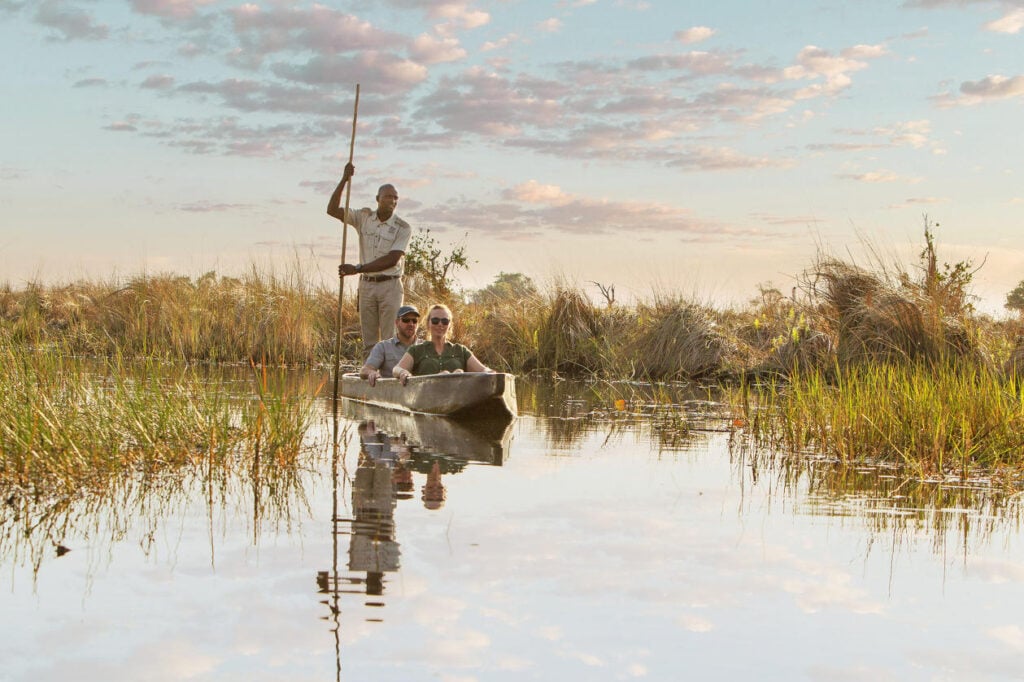
The Delta’s combination of mokoro (dugout canoe) game viewing, walking safaris on flood islands, and boat-based wildlife encounters is unique in Africa. The experience of tracking lion on foot through a flood island, or of approaching a hippo pod by mokoro with a guide managing the distance with a pole rather than a brake pedal, belongs to a different category of safari travel than a vehicle-based game drive. For experienced safari travellers who want to move their experience beyond open vehicle game drives, the Okavango is the natural next step.
Recommended Approach
First Africa safari: South Africa. The infrastructure, accessibility, price competition, and malaria-free options make it the most practical starting point. A first Africa safari should deliver reliable Big Five encounters without logistical friction; South Africa delivers both.
Second or third Africa safari: Botswana. Once you have the Big Five, the Okavango’s water-based experience and the Chobe elephant spectacle offer something qualitatively different. The higher price point is a secondary consideration; the experiential step-change is the reason to go.
Combined itinerary: Increasingly popular — fly Johannesburg, two nights Vic Falls (Zimbabwe side), three nights Chobe, light aircraft to Maun, three to four nights Okavango Delta, fly Maun to Johannesburg, connect to Cape Town. Twelve to fourteen days, three countries, the full range of southern Africa’s finest wildlife destinations. One of the continent’s strongest multi-country safari programmes.
South Africa vs Botswana Safari: Wildlife Comparison
Predators
South Africa’s Greater Kruger ecosystem leads globally for leopard sightings — Sabi Sands is simply unmatched anywhere in Africa for the reliability, proximity, and behavioural depth of its leopard encounters. Lion density and the quality of lion behaviour (hunting, cub-rearing, territorial conflicts between prides) is exceptional across both Kruger and the private reserves. Cheetah are present but not the consistent daily sighting they are in the Serengeti.
Botswana’s Okavango Delta offers a different predator profile: wild dog, which are reliably seen in the Delta’s dry-season concessions, produce one of Africa’s most dramatic wildlife experiences — a pack hunt covers kilometres of terrain and ends at speeds that make it genuinely difficult to follow even in a four-wheel drive vehicle. The Delta’s lion prides are large and well-established; leopard are present but less thoroughly habituated than in Sabi Sands. Spotted hyena in Chobe’s Savuti section produce some of Africa’s most dramatic large carnivore behaviour, particularly the Savuti lion-versus-elephant interactions documented over decades.
Elephant
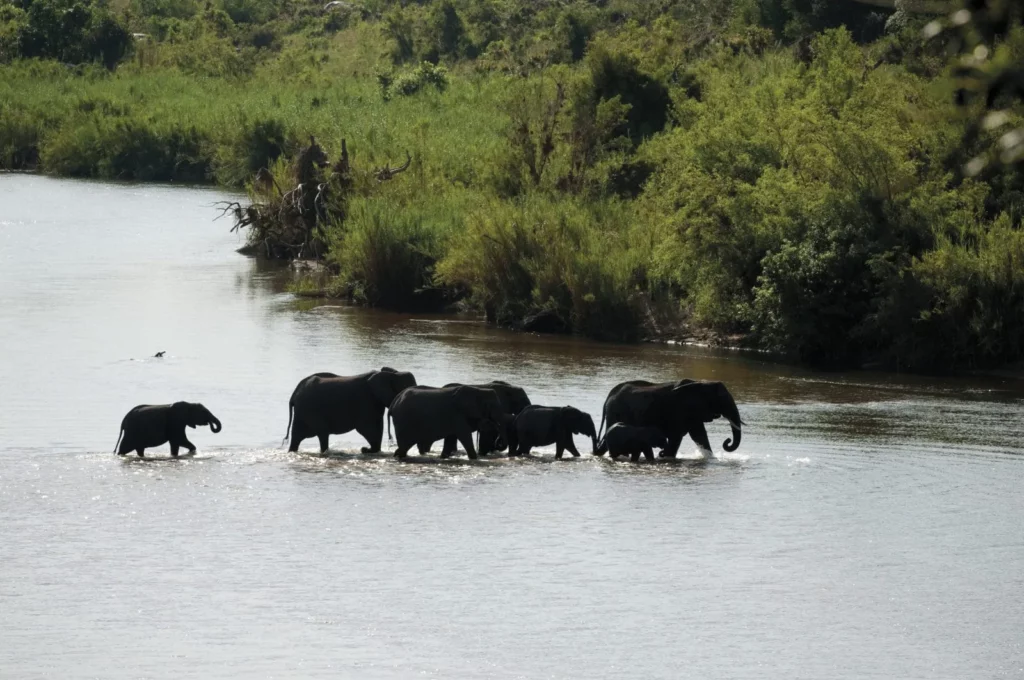
Both countries excel, but in different ways. South Africa’s Addo Elephant National Park carries the world’s highest elephant density in a compact area; encounters with dozens of individuals in a single morning drive are routine. The Eastern Cape’s private reserves offer intimate waterhole encounters with habituated herds. Botswana’s Chobe River concentrates the world’s largest elephant population — up to 50,000 animals converge on the river in the dry season, producing scenes of continental-scale abundance that are unlike anything South Africa can offer. The Chobe River boat safari at dusk, with herds swimming the river and dust rising from the southern bank, is one of Africa’s most cinematically overwhelming wildlife experiences.
Rhino
South Africa holds more than 90% of Africa’s remaining white rhino. Hluhluwe-iMfolozi, the reserve that saved the species from extinction in the 20th century, carries the world’s most significant white rhino population. The Eastern Cape’s private reserves offer reliable white rhino encounters in a malaria-free environment. Botswana’s main Chobe National Park carries rhino in very low numbers and sightings are exceptional rather than routine; the Okavango Delta’s northern concessions have small rhino populations that are rarely encountered.
Practical Comparison
| Factor | South Africa | Botswana |
|---|---|---|
| Malaria-free options | Yes (Eastern Cape, Pilanesberg, KZN south) | No — malaria throughout |
| Entry-level price (pps/night) | R5,000 (private reserve) | USD 400 (Kasane/Chobe lodges) |
| Premium price (pps/night) | R60,000+ (Singita, MalaMala) | USD 2,500+ (Mombo, Jao) |
| Self-drive viable | Yes — excellent road network | Chobe/Kasane yes; Delta is fly-in only |
| International gateway | Johannesburg OR Tambo (major hub) | Maun or Kasane (Chobe); via Johannesburg |
| Best for families | Yes — malaria-free Big Five options | Limited — malaria throughout, fewer family lodges |
| Unique experience | Sabi Sands leopard; Cape Town + safari combo | Okavango water safari; Chobe elephant massing |
The Combined Itinerary
For travellers who have ten to fourteen days and want to experience the best of both countries, the classic southern Africa circuit runs:
Day 1–2: Fly into Johannesburg. Same-day light aircraft or road transfer to Timbavati or Manyeleti (Greater Kruger) for two nights. Big Five game drives, predator focus.
Day 3–6: Transfer or fly to Kasane (northern Botswana). Two nights at a Chobe Riverfront lodge for elephant and river-based game viewing. Afternoon boat safaris on the Chobe River.
Day 7–10: Light aircraft Kasane to Maun, then to an Okavango Delta camp. Three to four nights: mokoro, walking, and vehicle-based game drives in the Delta’s private concessions.
Day 11–12: Fly Maun to Johannesburg. Optional extension: Cape Town for two to three nights before the return flight.
This circuit covers the Greater Kruger predator density, the Chobe elephant spectacle, and the Okavango water wilderness in a single itinerary — southern Africa’s most complete safari programme.
South Africa, Botswana, or Both?
African Safari Group plans and books southern Africa circuits combining South Africa and Botswana, and builds single-country programmes when that better fits your timeline or budget. Our specialists will tell you honestly which combination makes sense for your specific priorities.