
Sabi Sands vs Serengeti: Which Safari Should You Choose?
Quick Answer: Sabi Sands or Serengeti?
Choose Sabi Sands (South Africa) if your priority is guaranteed close-range Big Five encounters, world-record leopard densities, off-road tracking, and ultra-luxury private lodge comfort. Choose the Serengeti (Tanzania) if you want endless open plains, massive predator populations, and the legendary spectacle of the Great Wildebeest Migration.
Sabi Sands vs Serengeti: Key Differences Compared
| Factor | Sabi Sands (South Africa) | Serengeti (Tanzania) |
|---|---|---|
| Landscape & Habitat | Dense woodland, granite koppies & Sand River | Vast open grassland savanna & acacia woodland |
| Main Wildlife Highlight | Leopards & intimate Big 5 tracking | Great Migration (1.5M wildebeest) & lion prides |
| Off-Road Driving | Yes (strict 2-3 vehicle limits) | No (National Park roads only; allowed in private concessions) |
| Typical Daily Cost (pppn) | $650 – $4,500+ USD | $750 – $3,800+ USD |
| Best Season | Year-round (Dry winter May–Oct best for viewing) | Jan–Mar (Calving) / Jul–Oct (River crossings) |
Sabi Sands vs Serengeti: The Short Answer
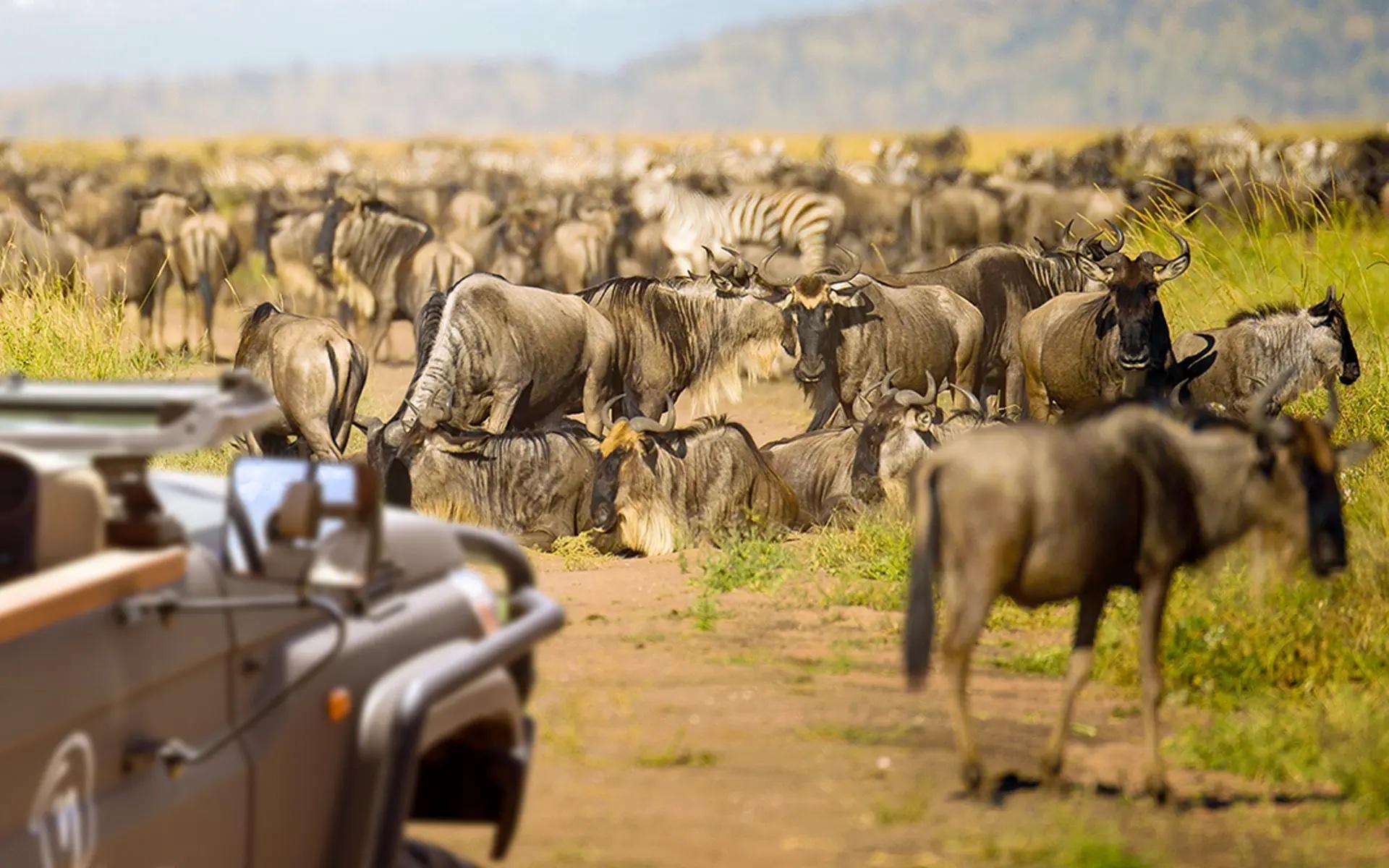
Choose Sabi Sands if your priority is big cat encounters — particularly the world’s most habituated leopard population — in an intimate, exclusive private reserve setting with all-inclusive luxury lodges. Choose Serengeti if witnessing the Great Wildebeest Migration — the largest mammal movement on Earth — is your primary goal, or if you want the scale and drama of East Africa’s open savanna. Both rank among Africa’s top five wildlife destinations; they deliver fundamentally different safari experiences.
Key Differences at a Glance
| Factor | Sabi Sands | Serengeti |
|---|---|---|
| Size | 65,000 hectares (private reserve) | 14,763 km² national park |
| Location | Mpumalanga, South Africa | Northern Tanzania |
| Signature experience | Habituated leopard, Big Five | Great Wildebeest Migration |
| Leopard sightings | World’s best — multiple per day possible | Good but unhabituated |
| Lion | Excellent — multiple prides | Excellent — highest density in Africa |
| Cheetah | Occasional | Outstanding — open plains ideal |
| Wildebeest migration | None | 1.5 million animals (July–October peak) |
| Malaria | Low risk (prophylaxis recommended) | Moderate risk (prophylaxis required) |
| Game drive style | Private vehicle, off-road, on-foot tracking | Shared or private 4×4, road-based |
| Lodge density | 50+ lodges — wide choice | Many camps across a vast ecosystem |
| Fly-in from | Johannesburg (1–1.5 hrs) | Arusha or Kilimanjaro (1–2 hrs) |
| Price range | USD 500–3,000+ per person/night | USD 400–2,500+ per person/night |
Why Is Sabi Sands Better for Leopard?
Sabi Sands Game Reserve is widely regarded as the best place in the world to observe leopard in the wild. The reserve’s population of habituated leopard — animals that have grown up in the presence of game drive vehicles and no longer treat them as a threat — allows guides to follow individual animals at close range for extended periods. Londolozi’s rangers have maintained unbroken records of individual leopard across four generations of cats since the 1970s. No other reserve on Earth matches this depth of behavioural knowledge or the reliability of sightings.
In the Serengeti, leopard are present but generally more secretive; sightings tend to be briefer and from greater distances.
Why Is the Serengeti Better for the Migration?
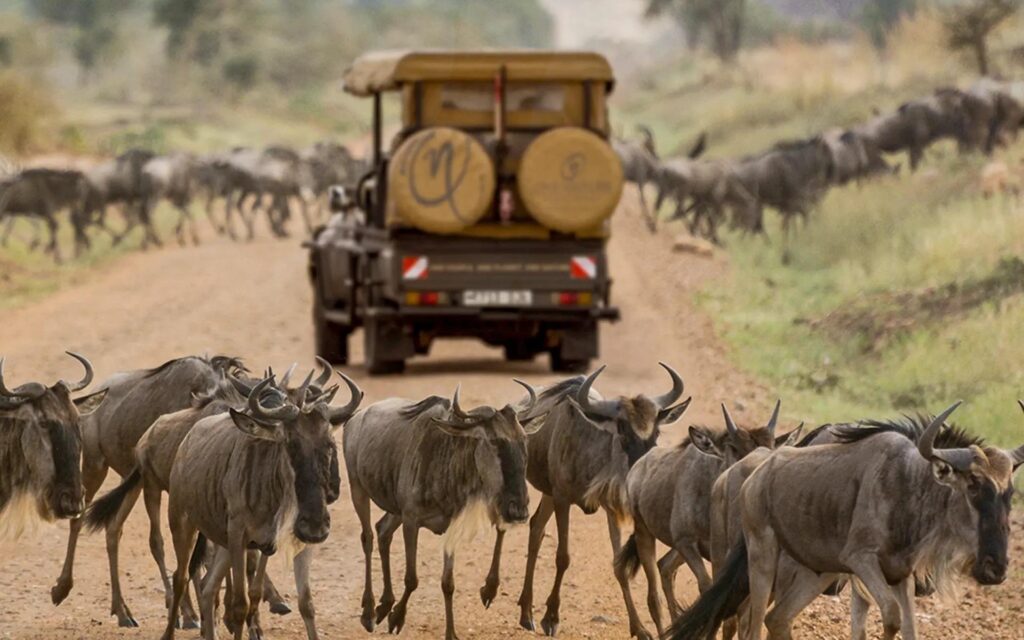
The Great Wildebeest Migration — involving approximately 1.5 million wildebeest, 400,000 zebra, and 200,000 Thomson’s gazelle — moves through the Serengeti ecosystem on an annual circuit. The most dramatic phase, the Mara River crossings (July–October), sees vast columns of wildebeest plunging through crocodile-filled waters at crossing points in the northern Serengeti and Masai Mara. There is no equivalent spectacle anywhere in Africa. Sabi Sands offers nothing comparable to this scale of movement.
Wildlife Comparison: What Can You See in Each?
Sabi Sands
Big Five (lion, leopard, elephant, white rhino, buffalo) with exceptional reliability. The private reserve model — off-road vehicles, expert trackers, maximum two vehicles per sighting — means encounters are intimate and extended. Wild dog are seasonal. Cheetah occasional. No migration but year-round consistency.
Serengeti
Lion (highest density in Africa — approximately 3,000 individuals), cheetah (open plains ideal), spotted hyena, wild dog, elephant. White rhino absent. Black rhino extremely rare. Leopard present but less habituated. The migration transforms the ecosystem seasonally.
Which Is Better Value?
Direct price comparison is difficult because experiences differ fundamentally. A mid-range Sabi Sands lodge (e.g. Elephant Plains, Nkorho) costs USD 400–700 per person per night fully inclusive. Equivalent Serengeti camps (e.g. mobile migration camps) cost USD 300–600 per person per night. The top-end properties in both destinations (Singita in Sabi Sands; Singita Grumeti in Serengeti) are similarly priced at USD 2,000–4,000+ per person per night.
Can You Combine Sabi Sands and the Serengeti?
Yes — and for guests with 10+ days, an East Africa and Southern Africa combination is one of the most rewarding safaris possible. A classic circuit: 3 nights Sabi Sands + 3 nights Serengeti (or Masai Mara for the river crossings) + 2 nights Zanzibar or Cape Town. African Safari Group designs these itineraries regularly for clients who want the best of both hemispheres.
Frequently Asked Questions
Is Sabi Sands or Serengeti better for a first safari?
Sabi Sands is the better first safari for guests whose primary goal is Big Five encounters, intimate wildlife experiences, and all-inclusive luxury. The Serengeti is better for first-time visitors who want the migration or who prioritise open-landscape East African atmosphere.
Which has better lion sightings — Sabi Sands or Serengeti?
Both deliver excellent lion sightings. The Serengeti has a higher total lion population (approximately 3,000); Sabi Sands offers more intimate encounters due to off-road access and lower vehicle density.
Is the Serengeti safe?
Tanzania’s national parks are safe for tourists. Standard safari safety protocols apply. Malaria prophylaxis is required for both destinations (though risk varies by season).
Plan Your Safari
African Safari Group designs both Sabi Sands and Serengeti itineraries — independently or as combined journeys. We match the right destination to your travel dates, wildlife priorities, and budget.
Enquire Now to start planning your safari.